

"[200M People & Zero Unicorns](https://medium.com/swlh/200m-people-zero-unicorns-building-the-next-great-startup-in-pakistan-fccef58318a4)" – so reads a title of one article about Pakistan's startup scene. It very much summarizes one of the hopes of our episode's guest – Ambareen Baig, Insights Lead at Invest2Innovate, a 3-arm Pakistani Accelerator, Venture Fund and Insights Lab.
 *We talked with Ambareen over Zoom in a live mode in August;* [*video verison of this episode*](https://www.youtube.com/watch?v=GYn_Ubr9AhA) *is available on SCOLAR Academy YouTube channel.*
But these two data points omit something very important in between: a booming tech scene, that has seen a [rapid growth in the last decade](https://www.dw.com/en/pakistan-the-next-big-asian-market-for-tech-startups/a-52183841). With Ambareen, we have made a virtual data-rich deep dive into the key dynamics within the young, yet promising innovation ecosystem of the South Asian nation.
Ambareen gave us multiple curious data points to paint a detailed picture of startup activities and venture capital flows in Pakistan over the last 5 years - such as, for instance, how international and local VCs investments differ value- and deal quantity-wise; where female entrepreneurs tend to find source of financing for their projects; and which sectors rose the most against the backdrop of the COVID-19 pandemic.

*"International VCs invested $91.9M in Pakistani startups from 2015-2020 (July) in 23 deals, while local VCs invested a total of $42.4M (in 42 deals) during the same time".* *Exlore* [*Deal Flow Tracker*](https://invest2innovate.com/deal-flow-tracker/) *for more data.*

*From: "*[*Covid-19 & Startups in Pakistan: Pivots, Partnerships & Future Positioning*](https://www.menabytes.com/covid-19-startups-in-pakistan/)*", an article by Ambareen @ MENAbytes.*
A lot of the mentioned data comes from the [Deal Flow Tracker](https://invest2innovate.com/deal-flow-tracker/), an adjustable database of traceable investments into Pakistan's startups between 2015-2020. Not only is it an exceptionally useful tool for anyone doing research about the trends in international & local investments into Pakistani startups; there are also several other value-added variables to compare the data, including the gender of each startup founder, startups' operating status, sector, amounts of financing raised, and a couple more.
Insights Arm under Ambareen's lead is on the respectable mission of facilitating VCs and individuals' – both from Pakistan & beyond – understanding of the country's innovation ecosystem with insightful research of various sectors from [grocery delivery](https://mailchi.mp/b33a236985b4/i2i-covid-startups-newsletter-april-6731998) to [edtech](https://www.menabytes.com/edtech-pakistan/). Be sure to check [i2i website](https://invest2innovate.com/insights/) to cover the whole range of their materials!
Thank you again Ambareen for talking to us; we'll definitely keep revisiting Pakistan's innovation market from different angles – stay tuned for the upcoming episodes!
Oct 11, 2020
31 min
## Медиа + предпринимательство = ?
**Герой нашего эпизода – Артем Жданов**, наиболее известный как главный редактор & основатель русскоязычного информационного источника о Поднебесной “[ЭКД!](https://ekd.me/ekd/)” ("Это Китай, детка!”), директор по маркетингу компании [UCHINA](https://uchina.biz/), а также основатель бренда [LaowaiMe](https://laowai.me/). Артем, которого мы поймали в Шанхае, проживает в Китае уже более 8 лет и постоянно экспериментирует с форматами креативного контента, позиционируя себя (как он сам говорит) как медийный предприниматель, вещающий **“О Китае – миру!”**.
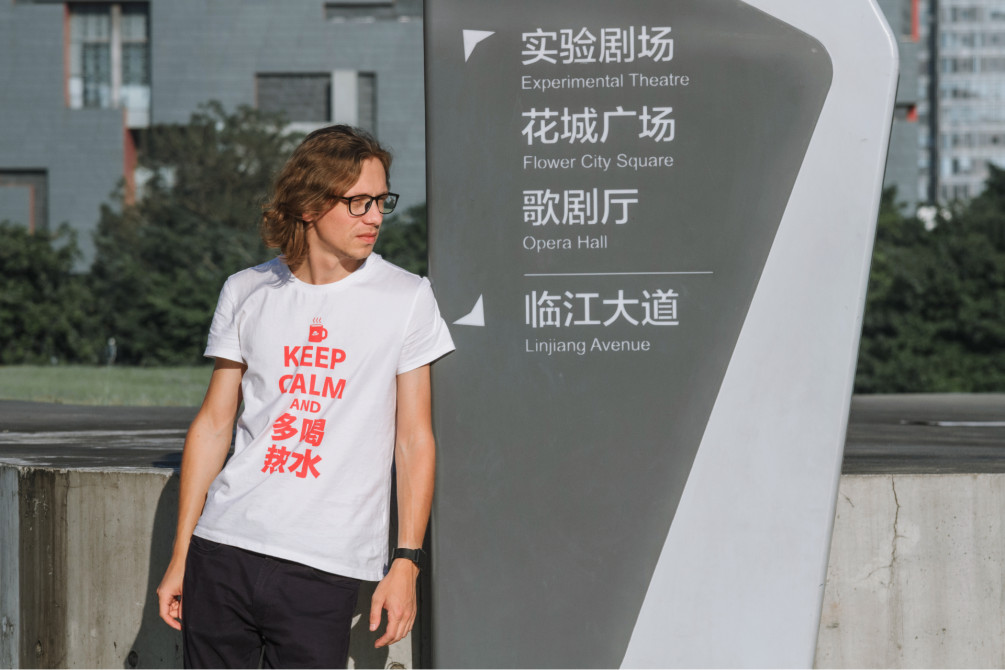
*Герой нашего эпизода, щеголяющий мерчем LaowaiMe.*
**Тема медийного предпринимательства красной нитью прошла через наш разговор**. Каково это – быть медийном предпринимателем, и что вообще интересно иностранцам, не живущим в Поднебесной? В этом разрезе мы поговорили и о бизнес-модели “ЭКД!" и том, как зарабатывать на медийных проектах.

*ЭКД! – инфо-ресурс о Китае, который Артем начал в 2012 как группу VK*
Поговорили и о других проектах Артема – в частности, о тех, которые были запущены недавно, во время / после карантина в Китае. Один из таких проектов – так называемая [влогументари "Celebrating China"](https://www.youtube.com/channel/UCUvAojGMxrLf3Q7QVniDfkw), которую Артем ведет с [иностранным инфлюенсером Уилльямом](https://www.youtube.com/channel/UCpPQO_EIa96Ts8O3MflskjQ) (拂菻坊 / Fulinfang), и цель которого – показывать зрителям отдаленные места Китая и знакомить их с традициями и бытом живущих там людей. Чем интересны китайская деревня и китайские города второго, третьего и более дальних эшелонов, и какие необычные проекты можно воплощать в китайской глубинке? У Артема на все эти вопросы в ответ – много интересных идей. Послушайте! Или посмотрите видео-версию этого эпизода на нашем [YouTube канале SCOLAR Academy](https://www.youtube.com/watch?v=1IP8TZW8-H4).

EKD: https://ekd.me/ekd/
UCHINA: https://uchina.biz/
LaowaiMe: https://laowai.me/
YouTube EKD, где Артем делает новостные обзоры: https://www.youtube.com/user/chinababeru
Sep 16, 2020
27 min
**420% growth in the number of higher education institutions in 3 decades. Which country are we talking about?** We bet Kyrgyzstan is not the one that comes to your mind first. Yet, like some other post-soviet Central Asian states, Kyrgyz Republic saw a dramatic spike in the number of HE institutions opening across the country as its government was faced with the challenges of establishing not only its Education system – but the very country itself. *But does more institutions mean better education opportunities?* *And what does it actually mean to be a good university and to produce a qualified graduate?*

*Our talk is also available on YouTube*: [*https://youtu.be/oNEwTwKc0X0*](http://https://youtu.be/oNEwTwKc0X0)
Shedding light on and unpacking these & some other dilemmas for us is **Emma Sabzalieva, an International Higher Education researcher based in Canada**, where she is pursuing a PhD at the University of Toronto.
Emma has a rich professional & academic background on the topic: she has worked in consulting and administrative positions with the governments and universities both in Central Asia and the West, and authored multiple academic pieces. One of my favourite ones is [on the challenges of creating a world-class univeristy beyond the West](http://https://www.tandfonline.com/doi/full/10.1080/21568235.2017.1292856), the established global core of higher education.
She also has **an amazing blog** where she's been gathering information – news pieces, academic research and her own notes and survey results on education & societal issues in Central Asia. Before visiting it, for instance, I had no idea [just how many Indian students there are in Kyrgyzstan](http://https://emmasabzalieva.com/2019/07/01/international-students-in-kyrgyzstan/); that Gorno-Badakhshan Autonomous Region in Tajikistan has [noticeably higher female participation rates in HE](http://https://www.universityworldnews.com/post.php?story=20160707140807406) than anywhere else in the country; and how rankings are playing such a growingly important role for universities in Kazakhstan that we see [manipulation of information for image-boosting](http://https://emmasabzalieva.com/2020/06/11/fighting-fake-news-in-kazakhstan/).
In our talk, we've managed to cover a range ot topics, so expect to hear about
• the challenges of privatisation in HE during the transition from the command to market economies;
• the prospects for intra-regional student and faculty exchange;
• the likelihood of any shared qualification standards;
and more – all topped with insights into just how different status quo is in each of the 5 Central Asian Stans.
*Key takeaway?* Higher education landscape in Central Asia is a complex one, with deep historic roots. Only once you start digging under the many layers of history, you will just how much human knowledge was generated here: many forget that it gave the world many great scientists and people of knowledge, including Ibn Sina (Avicenna), the key person behind the Medical Encyclopaedia that was used in Europe centuries after his death, and Timur's grandson Ulugh Beg, great patron of astronomy and a mathematician himself. Nowadays, it is also a region where countries will probably be having growingly more diverging characteristics, which will require case-by-case investigations and careful use of overarching terms – like "Central Asia" itself.


Aug 16, 2020
45 min
**Over 90% of foreigners in China speak ZERO Chinese?**
Turns out, yes. This figure was quoted by Ilya Cheremnikh, founder of Culture Yard Chinese Language School, whom we talked to two weeks ago. That weekend we decided to do something new with the SCOLAR Talk format, grabbed our tripods, microphones, cameras and phones, and set out to Beijing hutongs to talk to the Russian Israeli businessman and a Chinese language teacher, the main hero of our episode today.

Ilya's story is an interesting one: born in Russia, Saint Petersburg, he moved to Jerusalem in his childhood and reached China more than a decade ago to start a language school. We had lots of questions to ask from our guest – who was simultaneously "hosting" us in the cosy corner of the narrow-alleyed hutongs in central Beijing, where every day he is relentlessly working to reach his dream of "teaching Chinese language through culture".

The product of our experiment is a 25-minute video interview, where Ilya is sharing his and Culture Yard's stories, rewinds back to his university days when he first got interested in China & the Chinese language, explains how he came up with the idea of having a language school, and shares the experience of setting up a small business in Beijing.
You can find the video interview on our SCOLAR Academy YouTube Channel: https://www.youtube.com/watch?v=4fNWE6TPrWs
Please put a like if you enjoy watching it, subscribe to show your support and get updates on our new videos, and send us your thoughts and comments!
Culture Yard website: http://cultureyard.net/
Contact details:
Address: 10 Shique Hutong, Beijing
Phone: 010-84044166
Email: [email protected]
*Episode Transcript:*
**Olim Alimov, Host (Olim):** Ilya, where are we? *Илья, где мы?*
**Ilya Cheremnikh, Culture Yard (Ilya):** we are in Culture Yard. In the center of Beijing, in the middle of the Beijing hutongs. Culture Yard is a Chinese Language School and at the same time a Chinese cultural center. Basically, what we used to do before the Corona, we organized many events, lectures, Chinese film screenings, and Chinese language classes. A big part of them is that classes are very practical. We mostly teach people around different topics that can help them in their daily life, as well as [prepare] for the HSK exam. Nowadays most of our classes are online, because that’s where Corona has brought us. Now we're doing a bit of a similar thing where we teach people from all around the world in groups in an online live setting.
*Мы в Culture Yard. В центре Пекина, посреди пекинских хутунов. Culture Yard является школой китайского языка и одновременно центром изучения китайской культуры. По сути, до коронавируса мы организовали много мероприятий, лекций, китайских кинопоказов и уроков китайского языка. Фишка уроков в том, что занятия очень практичны. В основном мы обучаем людей различным темам, которые могут помочь им в их повседневной жизни, а также готовим их к экзамену HSK. В настоящее время большинство наших классов проводятся онлайн – Корона нас сюда привела. Сейчас мы учим людей со всего мира в группах в режиме онлайн.*
**Olim:** why hutong?
*Почему хутуны?*
**Ilya:** hutong, for me, is the historic centre of Beijing, the capital of China. And if you look – up until 50-60 years ago, this is what Beijing used to look like. And it still preserved a lot of that feeling, that culture. I also really like the felling that it’s low-rises, [there are] a lot of historic places, a lot of old Beijingers who live here. When you are based in this environment, you don’t feel the modern side of Beijing, you’re still connected to the roots of the capital. You still see the old people living their lives like they used to – they have
Aug 6, 2020
15 min
Welcome this show's east-most episode recorded so far!
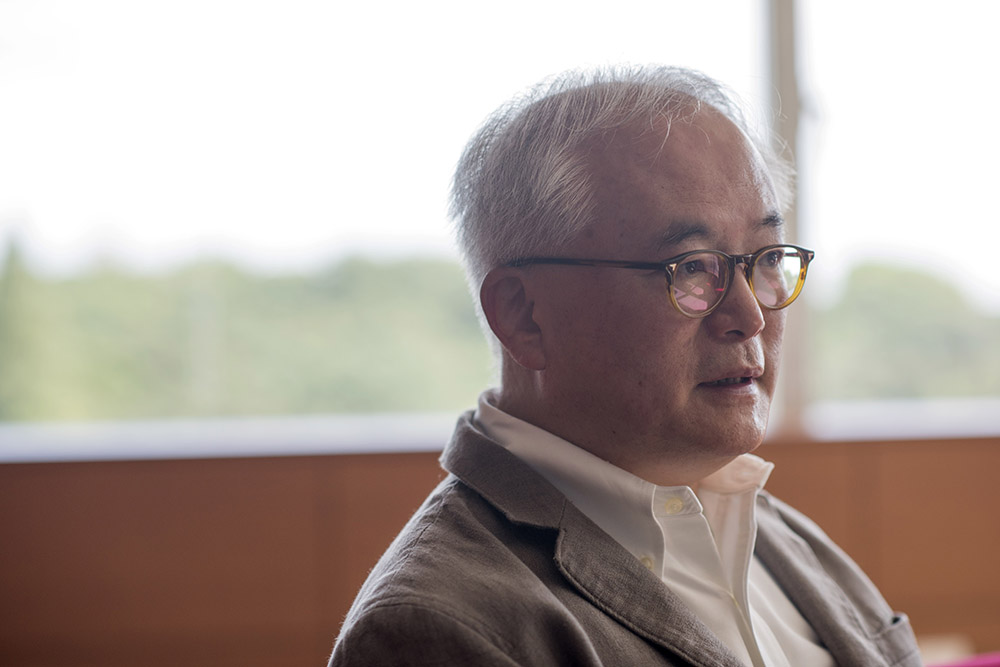
For the next half an hour, we will be looking at Eurasia from Tokyo with a rather special guest: **Professor Tomohiko Taniguchi, a speechwriter and special advisor to Japan's Prime Minister Shinzo Abe.**
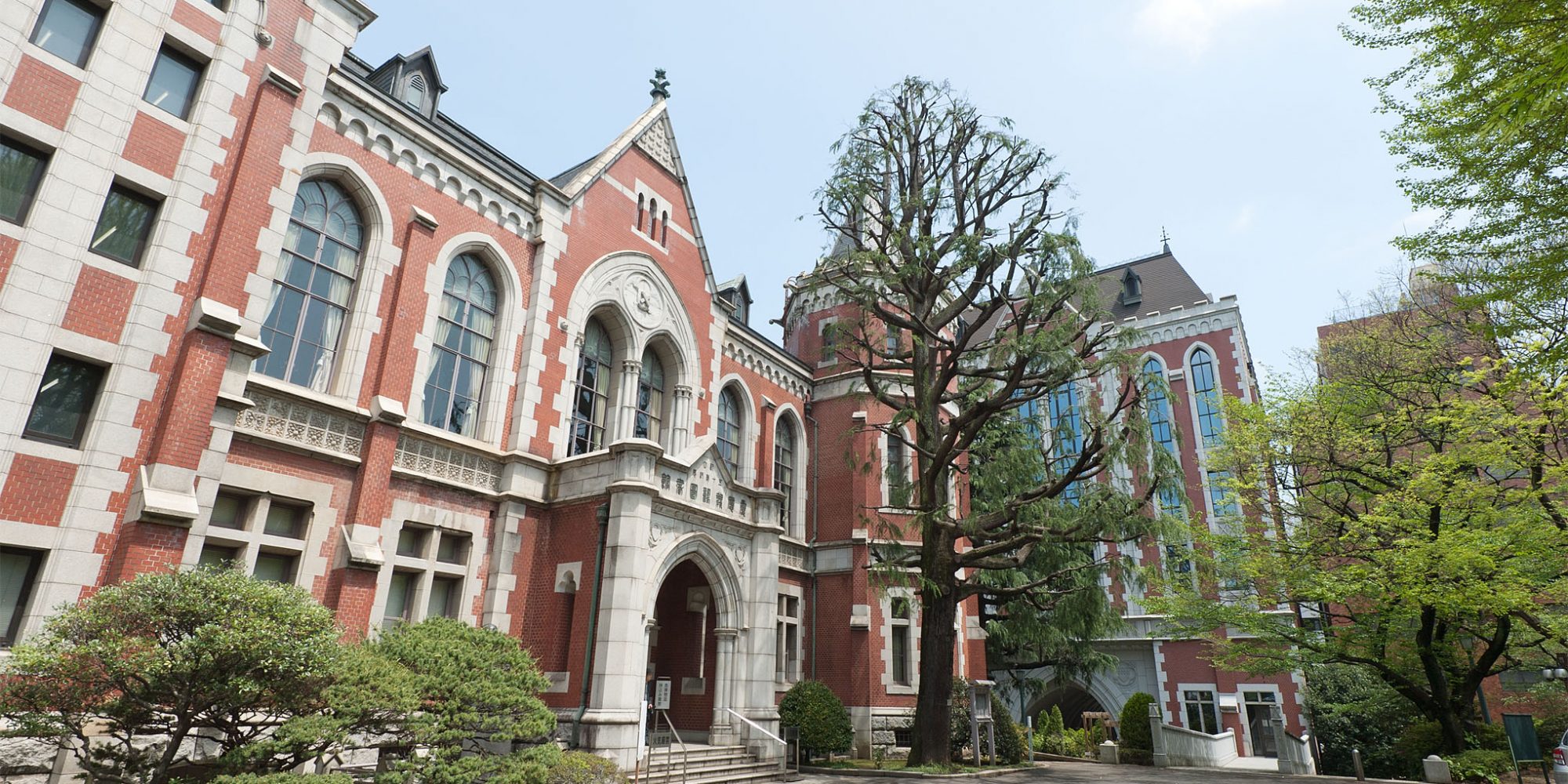
Professor Taniguchi also serves as a [tenured professor at Keio University](http://www.sdm.keio.ac.jp/en/voice/taniguchi.html) in Tokyo, Japan (and where Olesya, our interviewer, is based until January). Throughout his professional career, professor Taniguchi has changed his location multiple times, working as a researcher and journalist in several reputable institutions worldwide including [Nikkei Business](https://business.nikkei.com/), [Brookings Institution](https://www.brookings.edu/author/tomohiko-taniguchi/), Foreign Press Association, Princeton University and Shanghai Institute of International Studies. In 2005, professor Taniguchi joined Japan's Ministry of Foreign Affairs and started writing speeches for then-foreign minister Taro Aso, and subsequently PM Shinzo Abe.
**How difficult is it – to write a speech for the highest political figure in the country? How does Japanese government view developments in the Asian region, and where does it see its place? What is needed to encourage more Japanese companies to take part in the maritime and overland connectivity projects in Eurasia?**
We hope you will enjoy our guest's reflections on these questions as he is unweiling for us this mysterious island nation at the Eastern edge of the Asia Pacific.
See you in the next episode!
Jan 7, 2020
35 min
Welcome to all SCOLAR Podcast listeners!
The podcast team is back on the radars after the weeks of being attacked by flu & cold. Our guest today, interviewed by Sugarmaa Purevkhuu, is **Gu Xi – Chief Marketing Officer of Higgz Technology**, a 100-employee AI education company which uses adaptive technology to transform Chinese education scene and create an ecosystem for lifelong growth & learning.
Gu Xi is also widely known as a co-founder of women tech community TechieCat. As part of her activities to bring more women into the tech sector, she became a member of China Tech Alliance, initiated China’s first women tech conference TechieFestival, received a Women Impact Award 2016 by Shero China, and was featured in Apple’s global campaign “Behind the Mac”.
What does it feel like to work in a hectic Chinese 9-9-6 working week environment with colleagues, whose average age is only 23? How does Chinese innovation ecosystem differ from that in the West? How does coding help in a marketing job? Gu Xi gave us some really interesting insights into these and other questions, while sharing her own plans for the future. We are now curious to watch her further achievements, and hope you are too after listening to this episode. Enjoy!
Dec 1, 2019
35 min
Удивились новому голосу? Правильно: у нас пополнение в ряду ведущих. В этом эпизоде за микрофоном – **Сугармаа Пүрэвхүү** из Монголии, студентка доктарануры в городе Пекин и член SCOLAR Network.
Суграмее выпал уникальный шанс взять интервью у г-на **Максима Михалёва**, докторанта Института Этнографии Российской Академии Наук и соавтора книги “**Пояса и пути Евразии: В поисках человека**” во время его пребывания в Пекине, куда он прибыл по окончании его экспедиции в странах "Пояса и пути". История нашего гостя уникальна тем, что г-н Михалёв выбрал велосипед в качестве средства передвижения и один провел 100-дневную экспедицию, исследуя прогресс в Евразийских проектах инфрастуктурного развития и попутно узнавая мнения местных жителей в более чем 80 городах разных стран.

Что сподвигло нашего гостя на такое необычное путешествие? Как на самом деле локально протекает процесс Евразийской интеграции? С какими трудностями наш гость столкнулся в пути, и кого нужно опасаться в путешествиях – человека или волка?
Эти и другие интересные истории включены в нашем эпизоде – надеемся, вам понравится, и не забывайте подписываться!
Oct 16, 2019
23 min
Что из себя представляет предпринимательская среда Узбекистана? Как правительство все более экономически-открытого государства помогает молодым предпринимателям?

Мы объединяем эти две темы в одну в нашем новом эпизоде с **Абдулахадом Кучкаровым**, директором по инновациям организации **IT Park в Ташкенте**, который ранее руководил коворкинг-центрами GroundZero и пришел в IT Park после 7 лет опыта работы в области предпринимательства в Узбекистане.

IT Park – это уникальная организация, которая на фоне стремительно развивающегося внутреннего рынка Узбекистана ставит своей целью создание инновационной экосистемы и обеспечение комплексной поддержки старт-апов в сфере ИКТ. Парк открылся в июле этого года, но уже наполную проводит программы инкубации и акселерации, и в числе его резидентов уже более 15 местных компаний. Если вы наш слушатель из Узбекистана, заинтересованы в рынке ИКТ-технологий и, возможно, хотите воплотить в жизнь свой проект – эта беседа будет для вас особенно полезна. А нашим слушателям из других стран будет интересно на примере IT Parkа узнать о том, какие государственно-частные инициативы воплощаются сейчас в Узбекистане.


Надеемся, вам понравится! Не забывайте подписываться – и до встречи в новом эпизоде!
Oct 8, 2019
15 min
Today we bring you an episode about the Taihe Institute, an independent Beijing-based research institution, and its 3rd Taihe Civilizations Forum, which gathered 200+ participants from political, academic and media circles just outside Beijing at the outset of September. SCOLAR also attended the Forum as a co-organizer of the special youth session “AGORA: Taihe vision”, together with the APEC Voices of the Future, Global Shapers Beijing Hub 2, and G20 Young Entrepreneurs’ Alliance.
What does 太和 (tài hé) mean? Why, in the age of states, a young Chinese think-tank tells us to focus on the dialogue between civilisations? What does Taihe Institute do to bridge the gaps – not only between civilisations, but also between generations? Where does the youth come onto the scene, and what skills will it need to face the fast-paced global development? Exploring these and other questions with us in the first part of the episode is our guest Xinzhu (Vicky) He, Executive Director of Taihe Institute, managing its international cooperation programs. Vicky will walk us through the story behind Taihe Institute and the purpose of its annual forum, sharing her impressions as a moderator of the “AGORA: Taihe vision”. The second part of the episode will offer you views from the Forum’s young participants, who will share their own takeaways of the forum's conclusions.
We hope you enjoy, and don’t forget to subscribe to catch our new episode next week!
Taihe Institute website: http://www.taiheinstitute.org
Taihe Civilizations Forum: http://www.titcf.org
Oct 3, 2019
18 min
Сегодня мы с вами совершим свое собственное “Путешествие на Запад” – в западно-китайский Чунцин, внимание к которому с недавних пор сильно возросло в связи с активным продвижением города как центра развития внутренних регионов Китая. Вместе с нами это сделает наша гостья, **Ольга Зелковская.**
Ольга родилась в Минске, Беларусь, и окончила факультет межкультурных коммуникаций Минского государственного лингвистического университета. После этого судьба привела ее в Пекин, где она закончила магистратуру Пекинского университета по специальности сравнительная философия. Проработав в посольстве Республики Беларусь в Китае и Центральном телевидении Китая (CCTV), Ольга решила открыть для себя новые горизонты возможностей китайского рынка и в начале 2018-го года переехала в Чунцин. Там она открыла компанию по импорту белорусских продуктов питания «Валоша» и активно занимается профессиональной и культурной деятельностью для наращивания двусторонних связей между Беларусью и Китаем.
Что из себя представляет Чунцин, известный любовью его жителей к чрезвычайно острой еде? Насколько там, – в сравнении с Пекином, Шанхаем или Гонконгом – комфортно жить и развивать бизнес иностранцу? Как устроена жизнь в городе и как развлекаются местные жители? Какие сложности встают перед начинающими импортерами иностранных товаров и какие перспективы предлагает Чунцинский и Сычуаньский рынок потребителей?
Не забывайте подписываться на нас на удобной для вас платформе, чтобы не пропустить новые эпизоды. Надеемся, вам понравится!
Sep 25, 2019
42 min
Load more