By: Brian Christian and Tom Griffiths
24-MINUTE AUDIO / 3046 WORDS (13 PAGES)
SYNOPSIS
Can computer science teach us the secrets of life? Perhaps not, but it can shed light on how certain everyday processes work and how to exploit them. Algorithms are everywhere, from following a recipe to the order in which you sort your email.
In Algorithms to Live By, programmer and researcher Brian Christian and psychology and cognitive science professor at UC Berkeley Tom Griffiths share the many ways that algorithms shape everything from the way we remember things to how we make big and small decisions.

DIAGRAMS
TOP 20 INSIGHTS
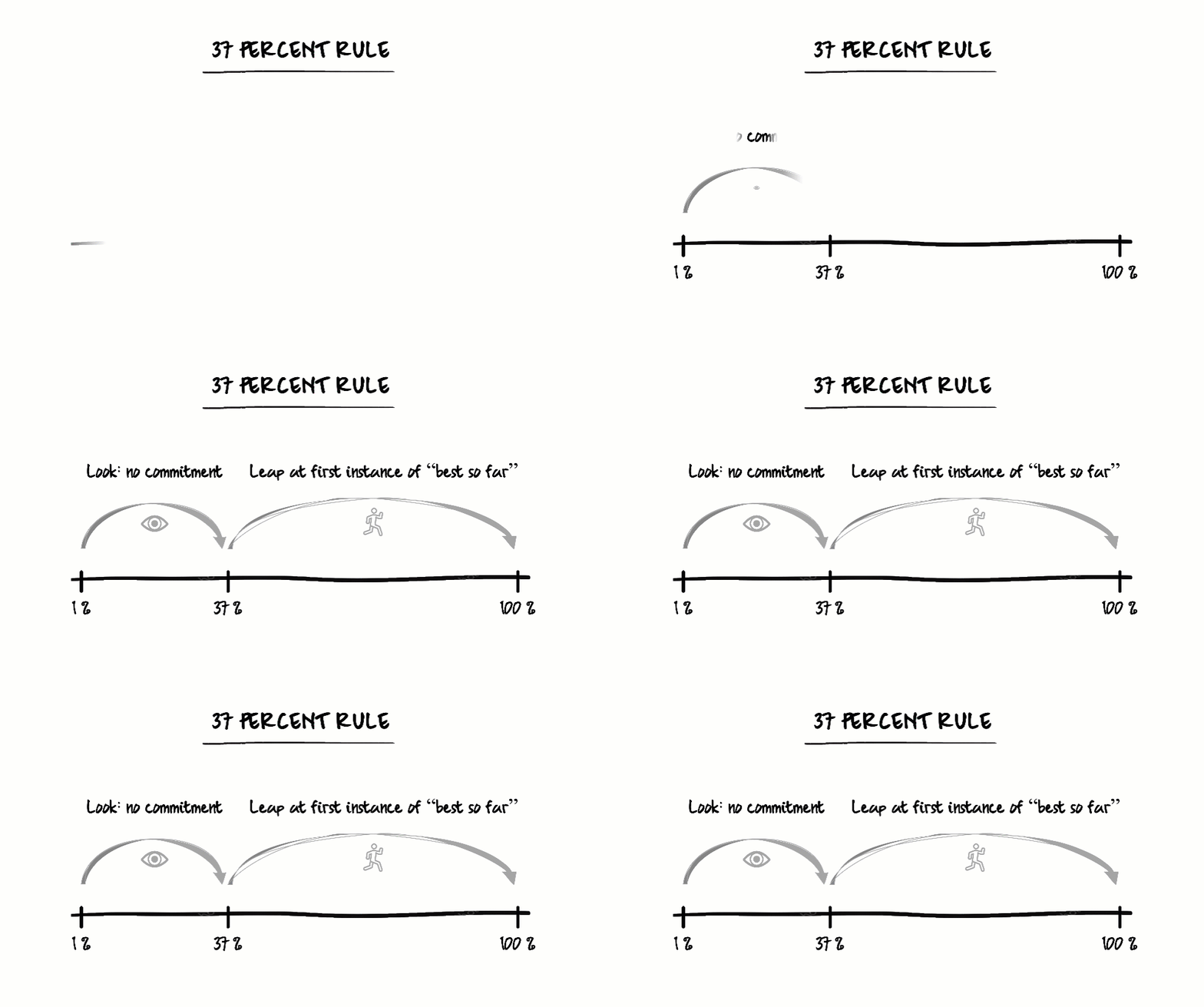
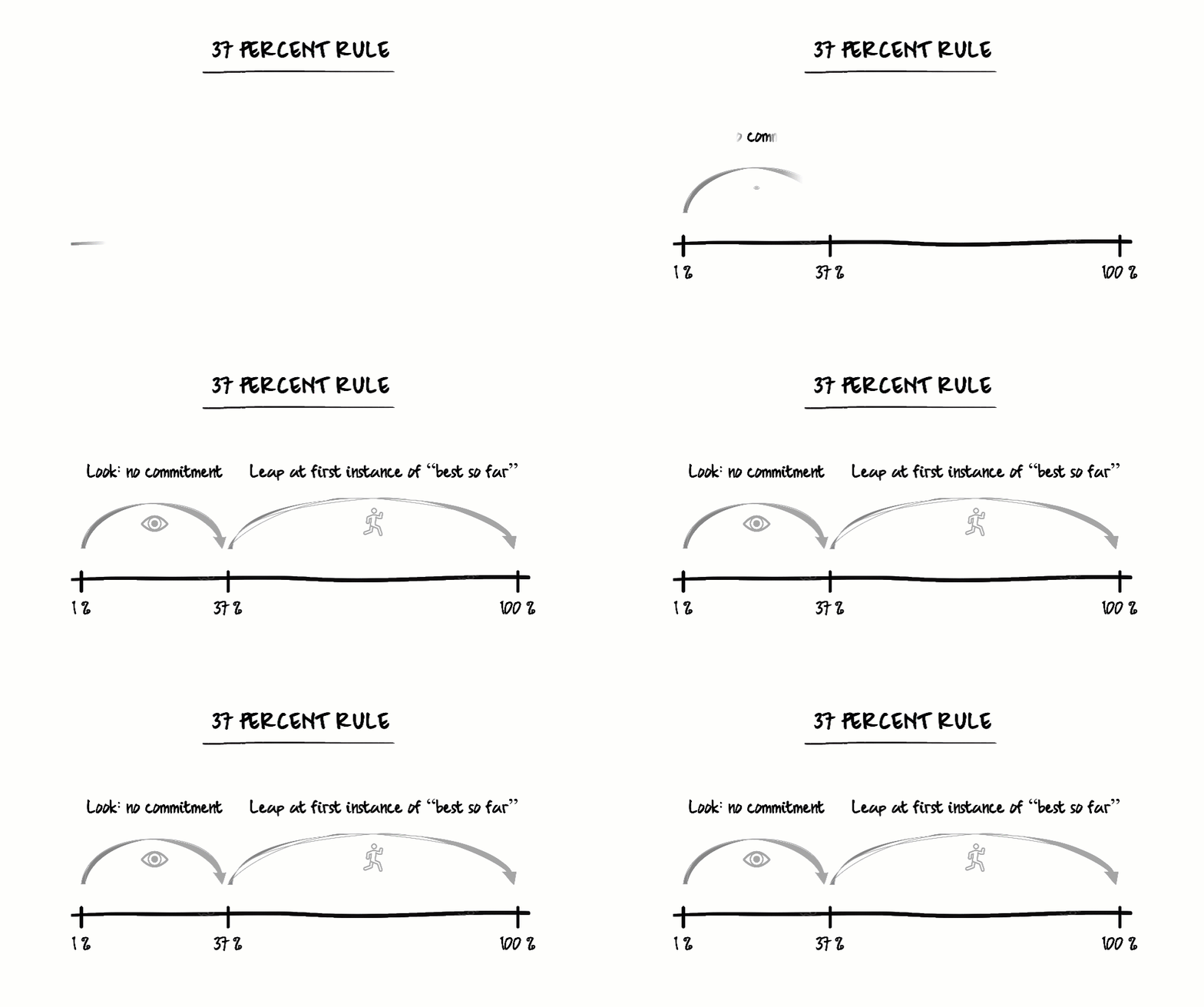
The "37% rule" refers to a series of steps, or algorithms, that someone must follow to make the best decision within a set amount of time. Someone allots 37% of their time to research before they make a decision, then commits to the very next "best choice" they find.
The "explore/exploit" trade-off refers to the need to balance the tried and tested with the new and risky. The payoff of this algorithm depends entirely on how much time you have to make decisions. People are more likely to visit their favorite restaurant on their last night in town than risk something new.
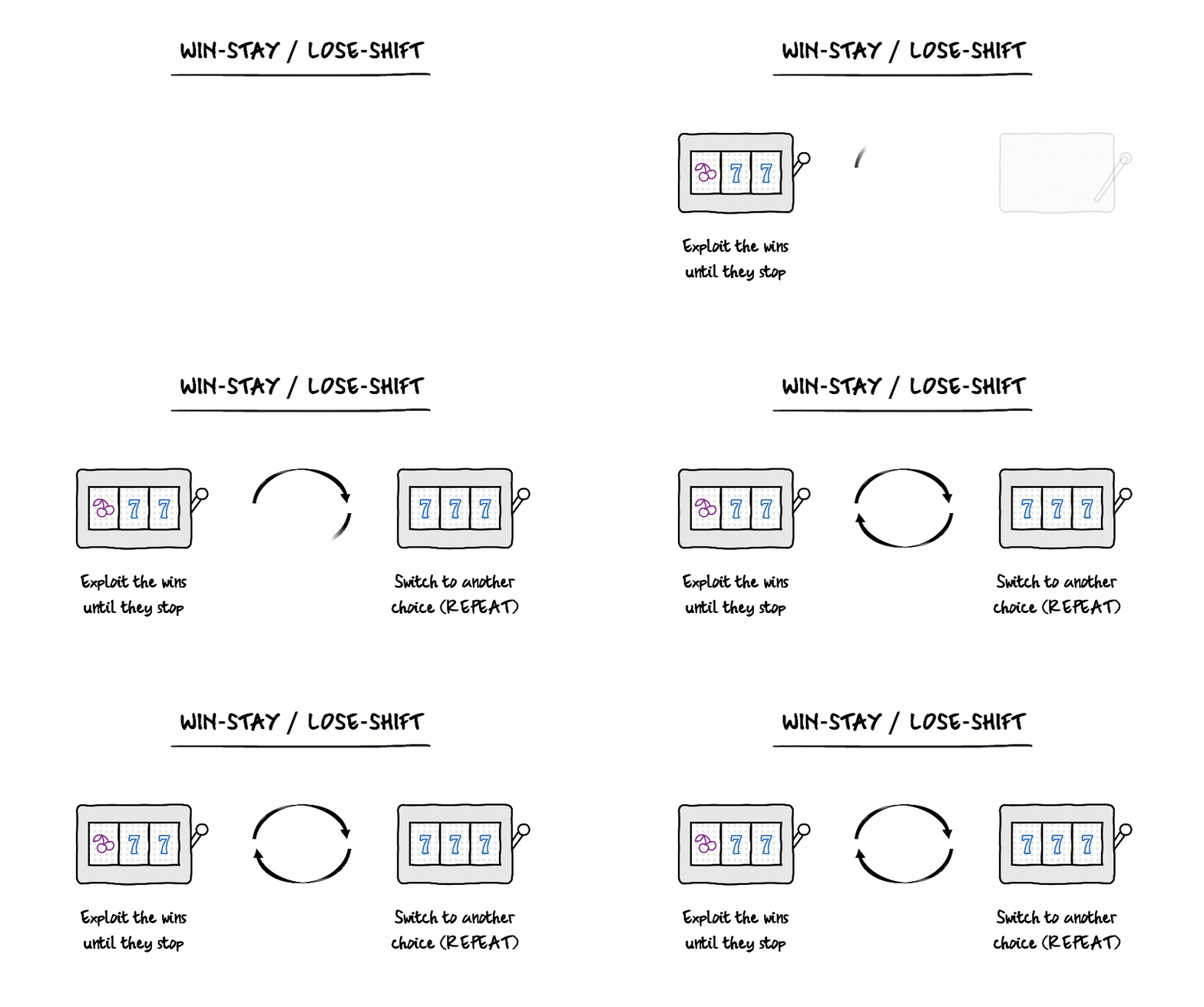
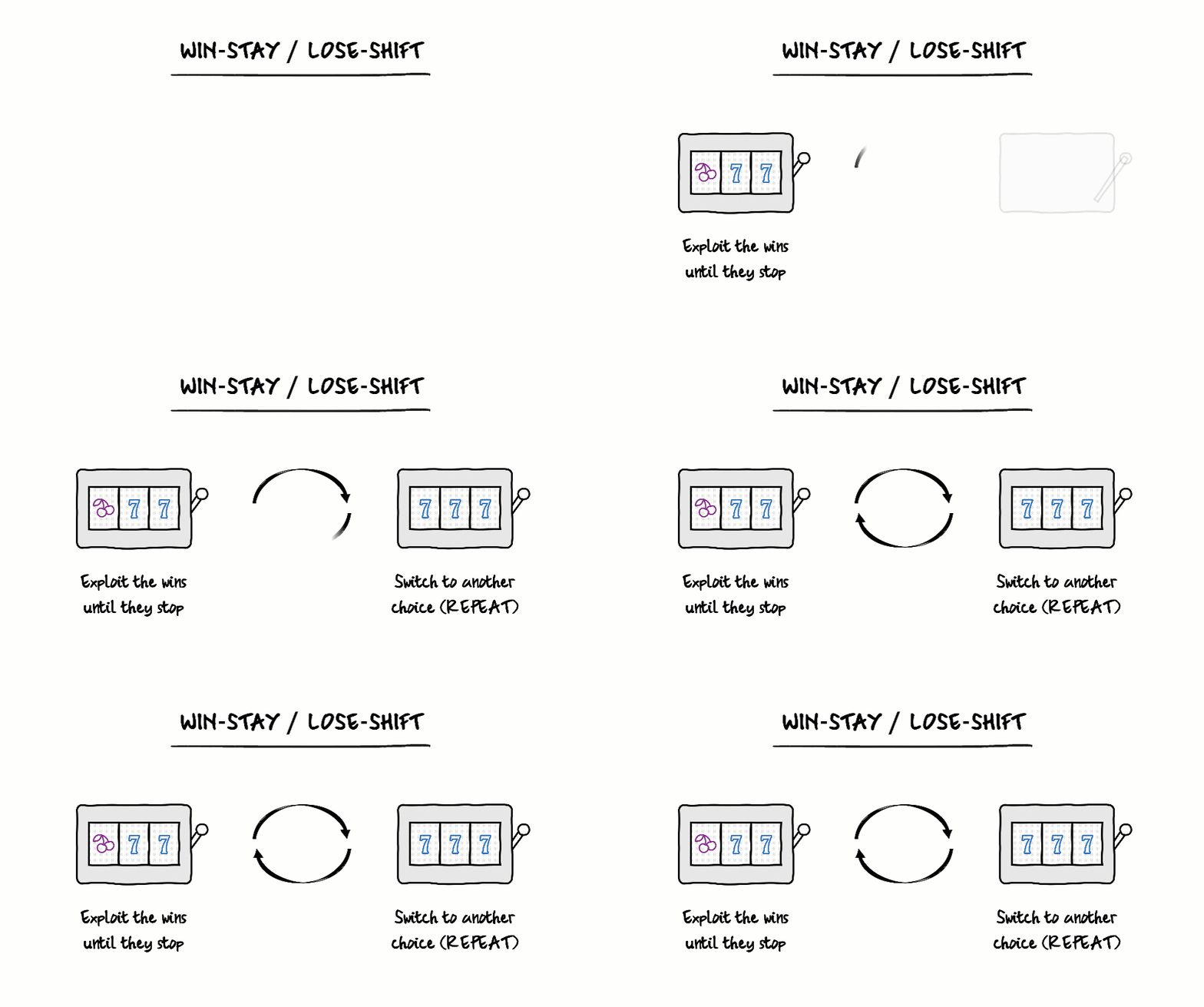
Developed in 1952 by mathematician Herbert Robins, the "Win-Stay, Lose-Shift" algorithm uses slot machines as a metaphor. Choose a machine at random and play it until you lose. Then switch to another machine; this method was proven to be more reliable than chance.
A psychology study found that given choices, people often "over explore" rather than exploit a win. Given 15 opportunities to choose which slot machine would win, 47% used Win-Stay, Lose-Shift strategies, and 22% chose machines randomly instead of staying with a machine that paid out.
Hollywood is a prime example of the exploit tactic. The number of movie sequels has steadily increased over the last decade. In both 2013 and 2014, seven of the Top 10 films were either sequels or prequels. The trend is likely to change if new movie ideas draw more box office dollars.
The A/B test is similar to the two slot machine scenario in that you stick with the option that performs best. More than 90% of Google's $50 million in annual revenue is from paid advertisements, which means that explore/exploit algorithms power a large portion of the internet.
The Gittins Index provides a framework of odds that assume you have an indefinite amount of time to achieve the best payoff, but the chances reduce the longer you wait. For example: choose a slot machine with a track record of one-to-one wins/losses (50%) over the machine that has won nine out of 18 times.
"Upper Confidence Bound" algorithms offer more room for discovery than the "Win-Stay, Lose-Shift" method. This algorithm assigns a value based on what "could be" based on the information available. A new restaurant has a 50/50 chance to provide a good experience because you have never been there.
The "Shortest Processing Time" algorithm requires that you complete the quickest tasks first. Divide the importance of the task by how long it will take. Only prioritize a task that takes two times as long if it is two times as important.
Laplace's Law calculates the odds that something will occur with only small amounts of data. Count how many times that result has happened, add one, then divide by the number of opportunities plus two. For example: Your softball team plays eight games per season. It has already won two games. 2+1/ 6+2=3/8, or a 37.5% chance you win the next game.
The Copernican Principle allows you to predict how long something will last without much of anything about it. The solution is that it will go on as long as it has gone on so far. Based on this principle, Google will reasonably last until 2044 (23 years since 1998 + 23 from 2021).
"Power-law distribution" considers that, in life, most things fall below the mean and a few rise above. Two-thirds of the US population makes less than the mean income, but the top 1% make almost ten times the mean. Few movies make "Titanic" level money in the box office, but some do.
The "Nash Equilibrium" explores the phenomenon of two-player games and the way that players form strategies that neither wants to change based on what the other person does. This creates stability. In Rock-Paper-Scissors with three options, players adopt a 1/3-1/3-1/3 strategy unless the other person changes tactics, and the process starts again.
Human brains have a nearly infinite capacity for memories, but we have a finite amount of time to access them. This results in the "forgetting curve." A study by Hermann Ebbinghaus found that he could recall nonsense syllables 60% of the time after he read them, but it declined to 20% after 800 hours.
Ebbinghaus' "forgetting curve" was shown to closely match how often words are used in society. The recurrence of words found in headlines of The New York Times declined at a rate of 15% over 100 days and implied that human brains naturally tune their processes to the world around us.
The stock market "flash crash" of May 6, 2010 was caused by an "information cascade." When one person does something different, then other people follow suit, assuming that the first person knows something they don't. This behavior causes people to panic buy or exhibit mob behavior.
Sociologist Barry Glassner noted that murders in the United States declined by 20% throughout the 1990s, and yet the mention of gun violence on American news increased by 600%. An information cascade can be caused more by public information than private information.
When authors Brian Christian and Tom Griffiths scheduled interviews for the book, they found that experts were more likely to accept a narrow, predetermined window than a wide-open one. It is less challenging to accommodate restraints than find another solution.
Believe it or not, randomness is part of life's algorithm, too. Nobel prize-winner Salvador Luria realized that random mutations could produce viral resistance by watching his friend win the jackpot on a slot machine.
The best-laid plans are often the simplest. Jason Fried and David Heinemeier Hannson, founders of software company 37signals, use a thick marker when they start to brainstorm because it limits room and forces them to keep it simple and focus on the big picture.
SUMMARY
Optimal Stopping
Look versus leap
Life is full of situations that require us to make the best possible decision in the shortest amount of time. Drivers search for the perfect parking space. Managers search for the best job candidate for a job, and property owners must decide on whether or not to accept a sale offer before the real estate market changes again. This dilemma is called "optimal stopping."
"Optimal Stopping" problems refer to dilemmas that require the best decision in the shortest amount of time. How do you balance the need to get all the facts with the need to act before it's too late? Common examples include searching for the perfect parking spot, when to rent an apartment before they're all taken and when to hire the best candidate for a job. The latter has been thoroughly examined and discussed by mathematicians since the 1950s.
This problem is known as the "Secretarial Problem."
If an employer interviews 100 secretary applicants, that person should allocate the first 37% percent of interviews to familiarize themselves with the talent pool and best qualities.
If they hire the very next applicant that appears to be the "best so far," the company has a 37% chance of that person being the best candidate.
The odds become greater with fewer applicants.
A renter on the hunt for an apartment in San Francisco might be inclined to take the first available unit due to high demand. If that renter needs to find a new place to live within 30 days, the "Optimal Stopping" algorithm suggests that the renter commit 37% of their time, or 11 days, to explore options without any commitment. On day 12, the renter must be prepared to commit to the first place that they consider to be the "best so far."
Explore versus Exploit
Laura Carstensen, a psychology professor at Stanford, hypothesized that people strategically reduce their social circles as they get older. In one study, people were asked if they would rather spend 30 minutes with an immediate family member, an author that wrote a book they read recently or someone they'd met who appeared to share their interests. Older respondents chose the family member, while younger people chose to make new friends.
When time was added or taken away, however, something interesting happened. If older people were allowed to live 20 years longer, their choices matched those of younger respondents. If younger respondents imagined they were about to move across the country, they chose family members instead.
Life is full of uncertainty, making the decision process that much more of a struggle at times. To take some of the life or death pressure out of the equation, let's turn instead to something a bit less dire – the casino slot machine.
Dubbed the "one-armed bandit," slot machines come with various payout odds that have baffled gamblers and fascinated statisticians for centuries. In 1952, mathematician Herbert Robbins proposed a solution to the age-old dilemma of whether you should hold out for the next big win or quit while you're ahead. He called this the Win-Stay, Lose-Shift algorithm.
Robbins proposed that a person should choose "an arm" at random (explore), then pull it as long as it pays off (exploit). Once the machine fails to pay, the person should move to another one, and so on.
Minimal Regret
Sometimes you have to weigh the risk with potential regret to find the solution to your particular problem. Amazon CEO Jeff Bezos had a steady, well-paid job on Wall Street before starting Amazon. The risk of the first online bookstore, he found, was outweighed by the possibility that he might regret not trying, a "regret minimization framework."
"I knew that when I was 80, I was not going to regret having tried this," Bezos said. "I was not going to regret trying to participate in this thing called the internet that I thought was going to be a really big deal. I knew that if I failed, I wouldn't regret that, but I knew the one thing I might regret is not ever having tried."
"Upper Confidence Bound" algorithms offer more room for discovery than the "Win-Stay, Lose-Shift" method. This algorithm assigns a value based on what "could be" based on the information available. A new restaurant has a 50/50 chance to provide a good experience because you have never been there.
Algorithms can't guarantee a life without regret, but they show how our willingness to take risks is reduced by how much time we think (or know) we have to take them. When we are children, we explore our worlds and discover new things with great enthusiasm. As we grow older, we tend to rely on the "tried and true" decisions based on what we've learned, i.e. exploit them.