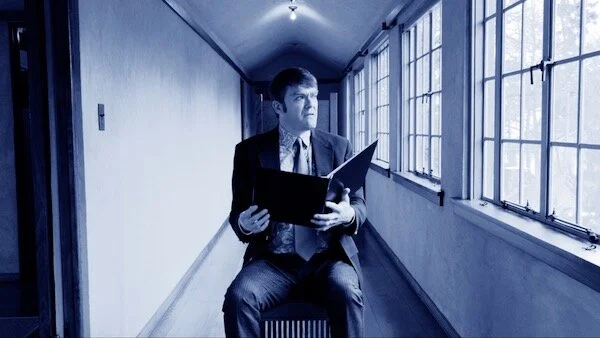
If you’ve been listening a few years, you may recall that I shared a Dickens’ A Christmas Carol three years ago (episode 008). That was the fuller version that I read for 20 years at First Baptist Church in Westfield, NJ, essentially the version that I grew up hearing my father perform as a special Christmas Eve service for the church congregations he served. The Rev. Gilbert J. Horn developed his adaptation (replete with rich vocal characterizations) in the 1960s, and I started doing it in 1996. Dad’s version was already quite condensed as compared with Dickens’ original text, but the one I’m doing here is only about half as long as that. (Photo: John Opera)
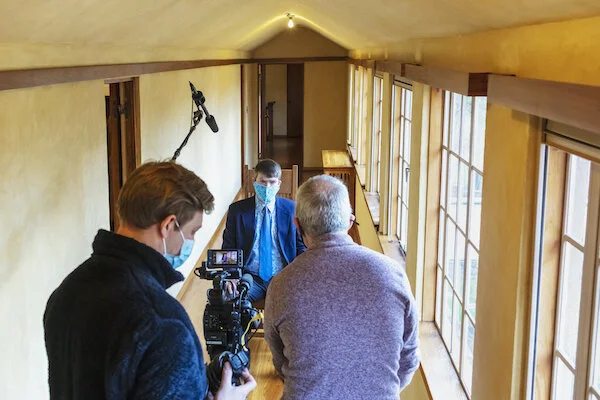
But that’s not the only difference! It may be sacrilege for a podcaster to urge you to watch instead of listen to an episode, but I’m going to make that case. This special performance was conceived as a benefit for Graycliff Conservancy here in Western New York, the organization charged with taking care of Graycliff, the magnificent summer home that Frank Lloyd Wright designed for Darwin and Isabelle Martin in the 1920s. Executive Director Anna Kaplan asked me if I’d be willing to do a videotaped performance as a holiday offering. As soon as I prevailed upon my oldest best friend, UB photo professor John Opera, to help me out, we started on a wild ride dreaming of how to do this in the coolest way possible. Graycliff provided for us to bring in Full Circle Studios (who filmed episode 029) to record sound and video, and we were fortunate that four members of Buffalo’s Vocalis Chamber Choir volunteered to serve as our Graycliff Carolers. You’ll hear Mike Alessi (bass), Claudia Brown (soprano), Maria Parker (alto), and Vocalis founder and director James Burritt (tenor) throughout the production.
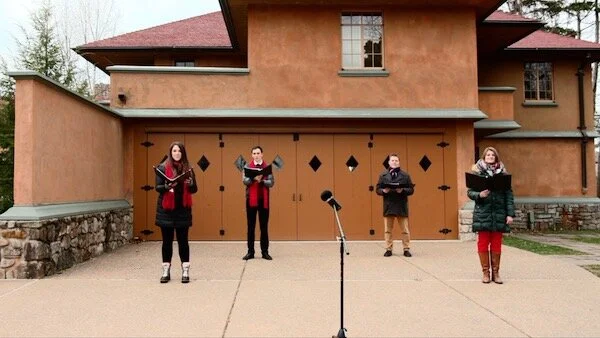
From left, Maria Parker (alto), Mike Alessi (bass), James Burritt (tenor), and Claudia Brown (soprano), members of Vocalis Chamber Choir
Before and after each stave of the story, the carolers sing in the driveway just outside the garage door. If you’ve visited Graycliff, you may notice that the colors in this video pop a little brighter than you recall. Professor Opera, who did visual design for the project, wanted to warm up the exterior shots and cool down everything inside, so he processed all of Full Circle’s raw video digitally, using state-of-the-art techniques to achieve a distinct visual profile for every scene.
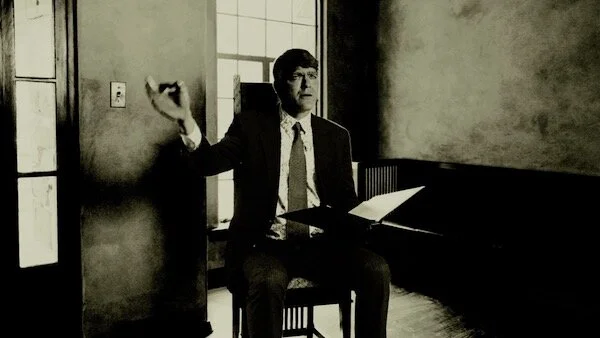
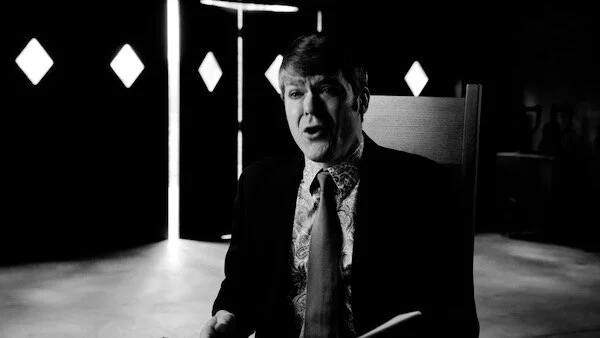
From Stave 2, Marley
The look of the section where Scrooge is visited by the ghost of his old partner Marley recalls Louis Daguerre’s daguerreotypes from the 19th century. Dickens himself was photographed in daguerreotype at various points throughout his career.