

Once upon a time there was a preacher
They were good people,
people who loved Jesus,
people who had embraced the Christian way of life.
But there came a time
They were tired—
tired of serving the world,
tired of worship,
tired of being seen as peculiar
and whispered about in society,
tired of the spiritual struggle,
tired of trying to keep their prayer life going.
Attendance at church was down,
and many of them were in danger of drifting away,
of leaving the community and falling away from the faith.
It’s a problem that can strike any faith community at any time.
it can happen to individuals, to families, to parishes, to dioceses,
and even to entire nations.
Well, once upon a time
and so the preacher
wanted to give his people a message of encouragement.
He wanted to deliver a sermon
that would wake them up,
give them strength,
give them hope,
encourage them to keep going
in their walk of faith.
What he produced was perhaps
And we don’t even know his name.
or who his congregation was.
But we do have his sermon.
We’ve been reading portions of it on Sundays
for the past three weeks,
and we’ll hear from it again next week.
The Letter to the Hebrews
Despite its name,
it’s not really a letter, and it’s not really written to Hebrews.
What it is though, is the most beautiful of sermons,
meant to encourage an early Christian community
suffering from spiritual fatigue
to persevere in the faith.
That encouragement is for us, too,
and would just as soon drift away from our faith.
The Letter to the Hebrews is written to lift our hearts,
to pull us back together,
to renew our spirits.
We saw that encouragement last week
compared our spiritual journey to being on the race track in a stadium,
surrounded by thousands of spectators in the stands,
the great cloud of witnesses that have come before us.
As Monsignor Steiner said last weekend,
it’s like being in the Olympics,
where the roar of that cheering crowd
stirs our hearts and pushes us to do our best,
to be our best.
When we feel exhausted and weary of our Christian discipleship,
the great cloud of witnesses, the saints,
are cheering us on to keep running the race,
to not give up.
This week we get a different image,
The preacher of Hebrews acknowledges the difficulties
of living our Christian faith.
But this is not a punishment, he says.
“Endure your trials as ‘discipline,”
says the preacher,
“For what ‘son’ is there whom his father does not discipline?”
This is echoed in today’s gospel
“to strive to enter the narrow gate,”
that many “will attempt to enter but will not be strong enough.”
It is no accident that the words discipline and disciple are related.
Being a disciple takes work, dedication, and trust.
It takes discipline.
You can really see this kind of discipline clearly
There’s a section of that movie that wonderfully illustrates
what the preacher of Hebrews is saying today.
If you remember the movie,
from New Jersey to an apartment in California.
He begins to get bullied by some boys who know karate,
he is rescued by the maintenance man at his apartment,
old Mr. Miyagi.
Mr. Miyagi uses karate to defend Daniel and chase the bullies off.
Now, Daniel wants to be able to defend himself,
They even have a sort of covenant ceremony,
in which Mr. Miyagi ties a headband around Daniel’s head
and says,
“I promise to teach you karate,
and you promise to learn.
I say, you do, no question. Deal?”
And Daniel agrees.
It’s at this point that Daniel becomes, in a way, a disciple of Mr. Miyagi.
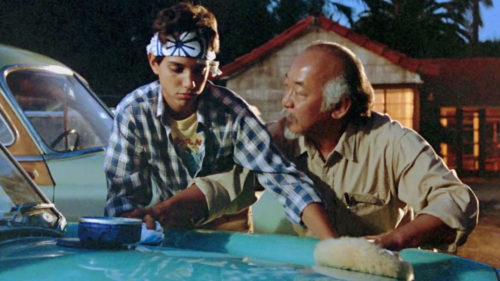
And the first thing Mr. Miyagi does is hand Daniel a bucket of water
It’s the most famous scene in the movie, when Mr. Miyagi tells Daniel,
“Wax on with the right hand, wax off with the left.”
“Wax on, wax off. Breath in through the nose out through the mouth.”
Daniel doesn’t understand what this has to do with karate,
but he’s just promised to do as he is told,
so he picks up the bucket and begins.
There are a lot of cars, and it takes Daniel a long time.
After he’s done washing and waxing the cars,
Mr. Miyagi gives him two Japanese sanding blocks
and tells him to sand the floor.
“The floor” is the huge wooden walkway in his backyard,
and Daniel has to get down on his knees
and make large circles with the blocks
sanding day after day.
Then after he finishes that,
Daniel has to paint the tall wooden fence
that surrounds Mr. Miyagi’s property
using long strokes, up and down,
painting the long boards with the right hand,
and the short boards with the left hand.
It’s exhausting work, especially in the California heat,
he wanted to learn karate.
Instead, he’s frustrated and sore,
and he feels like a slave.
This is how the preacher’s community feels in the Letter to the Hebrews:
This is how we can sometimes feel,
wondering when all our trials will bear fruit.
Daniel confronts Mr. Miyagi,
of not teaching him karate.
Daniel starts to walk away, ready to give up his training, his discipleship,
when Mr. Miyagi calls him back,
and tells him that he has been learning karate all along.
He says, “Show me wax on, wax off.”
When Daniel makes the motion of waxing on and waxing off,
Mr. Miyagi shows him how that is a defensive karate move.
Mr. Miyagi goes on to show him how each of the tasks he’s done
has trained his body to do a different karate block.
Wax on, wax off,
sand the floor,
paint the fence,
these have all been building muscle memory,
and when Mr. Miyagi begins to throw punches and kicks at Daniel,
he is able to fend them off with the moves he has learned.
Mr. Miyagi has taught Daniel discipline, but also trust.
We are all sons and daughters of our heavenly father,
when we feel like the burden of discipleship as a punishment,
when we, like Daniel, are ready to walk out and give up.
But the Letter to the Hebrews reminds us
the discipline of being patient with our families,
trying to live honest lives,
forgiving those who wrong us,
speaking well of others.
It’s also the discipline of serving the poor,
of coming here to worship with this community.
Each day we wake up with the tasks of being a disciple,
That is the discipline of being a disciple of Christ.
The discipline imposed by Mr. Miyagi
who was able to learn karate and defend himself;
and the discipline imposed on us by our baptism into Christ
will bear fruit for us,
who hope to pass through the narrow gate
and experience the joy of eternal life.