The Elusive Symbolism of Dreams & Death—Julius Töyrylä
 Listen above, on Spotify or Apple Podcasts. Transcript:
I’m Alexa Ashley and this is Eyes Wide. In this episode we hear from artist and photographer Julius Töyrylä, who has been recording his dreams since he can remember. In 2018, he woke up from a particularly meaningful dream, remembering two words he didn’t understand. He inquired with linguistic professor Michelle Black and learned that the words were from an Indigenous language spoken in the Andes region, and also in his birthplace of Colombia, from where he was adopted to Finland. The language is called Quechua.
When he was five years old he was told by his Finnish parents about a birth sister who passed away before he was born. The incident left him with an eerie feeling about someone, somewhere, invisible.
In his latest photography project Black Book, Julius reshapes and analyzes his dreams with the medium of photography. His photos often contain a woman figure, usually without a face, and objects from nature depicted in a twisted and surreal kind of way. After viewing his exhibition at Taller Sangfer in Oaxaca City, Mexico, I sat down with Julius to explore the elusive symbolism of dreams and death.
Alexa Ashley: To start, tell me a little bit about growing up as you.
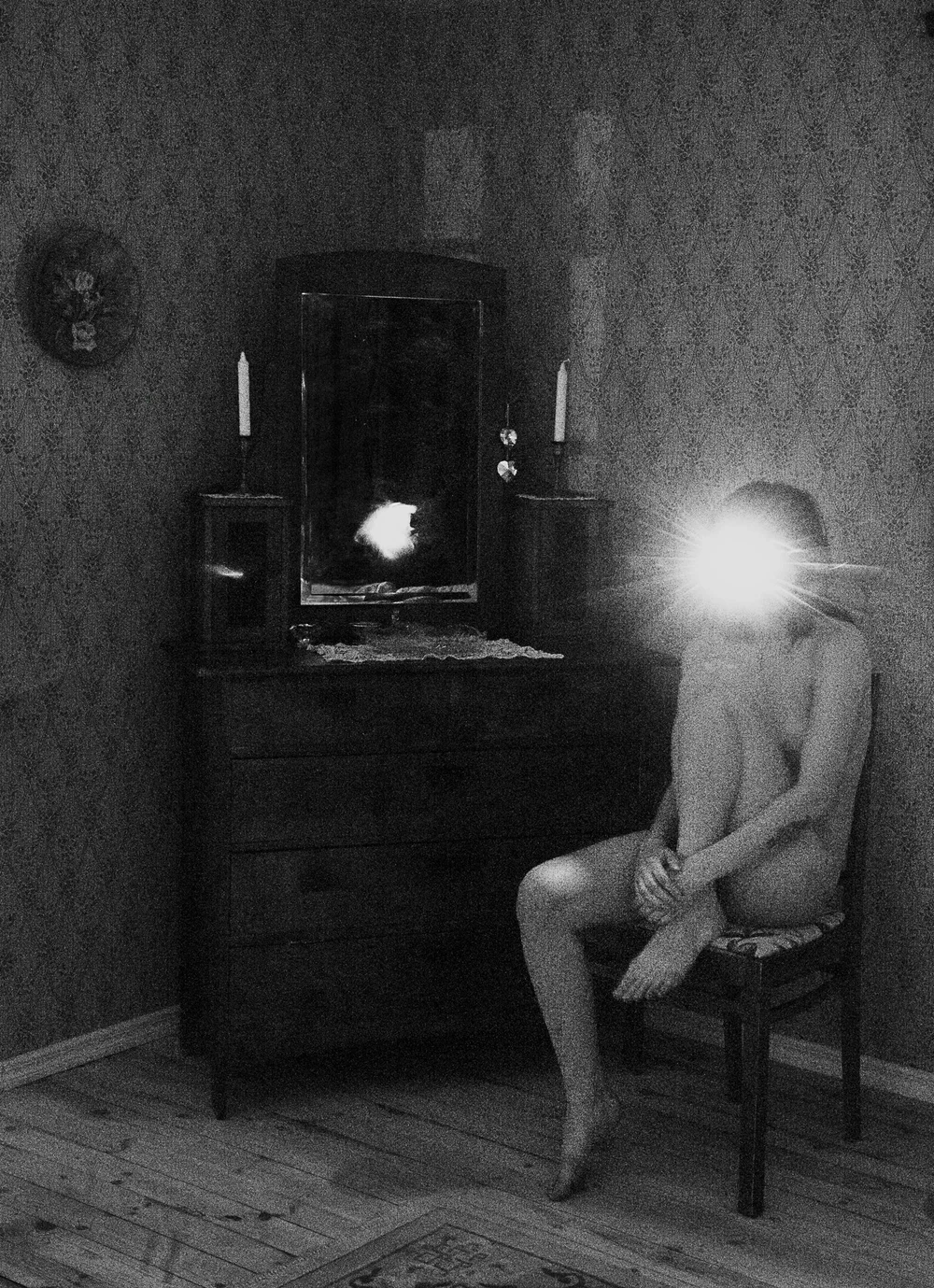
Julius Töyrylä: Oh, that’s a good question. We’re going hard from the beginning I guess. Damn. I was really lonely because I was an only child. And you were in the exhibition and saw some of the works there. So there was the picture of the woman sitting and she has the light in front of her face. There’s a story behind it, close to my life also. Do you want to hear it?
Alexa: Please.
Julius: Do you want the short version or the longer version?
Alexa: Whatever you’re willing to give me, Dear.
Julius: I want to give you the longer one. Ok, let’s go. Before I was in our family of now three people, I had a sister. But she unfortunately passed away after birth.
Alexa: I’m sorry.
Julius: Yeah, I know. And then I was adopted from Colombia to a Finnish family. And they told me a story when I was like five years old or something like that. But I’ve always had this strange feeling that there should be someone there, and there’s nobody. But also a feeling of like something similar, like the feeling that you have a sister but you don’t. Hard thing to explain; but anyway.
A few years back from here, we were on vacation, my family. In Spain. And I was just looking at the sea. And then, this strange dreamlike feeling came over me for some reason, and it started to get dark. It was like a perfect moment in a way. And then I looked at the sea and I looked at how it waved, back and forth, and I got this feeling that now is the time to remember her. Her name is Paula. And I was like, “Hm, what can I do now to really remember her?” Not just a memory but something else in a way. And I didn’t have my camera with me, so I was like, “Maybe I do an act or something.”
So, then I decided, as it got dark, I saw the stars. I thought, “Let’s be romantic.” And I looked at the sky and I was like, “I’ll go under the brightest star and I’ll get something from the ground.” Memorabilia or an amulet or something from that moment, because it was so strong. Then I started to walk, like five kilometers away. Then I got to the spot, I was looking up and was like “This is it.” It was like a beach, a rocky beach.
And so I put my hand down and got something from the ground. It was like a little stone. But what is strange to me at least is that the stone was a little heart-shaped. I’m not making this up! It felt like it had a lot of emotion. It was a green one. I got it back to Finland. It was 2019, so I started working with this project “Black Book” in 2018, so just a year later this happened. And so I went to Finland and thought, “Now I have the rock in my bag, incorporate that into my work.”
In my exhibition, the woman with the light in her face but also the rock. I also made the portrait of my friend back in Finland. And the reason for the light, for not seeing the model’s face is because some of my dreams are really abstract. And there’s these really strong dreams that have this—it’s hard to explain—but a strong feeling behind them. And in those dreams there’s a woman figure—for some reason, she never has a face. So that’s the reason behind that series of photos.
I also brought that stone with me there. So it’s in the corner of the exhibition there. That’s the story behind that picture and also what it was like growing up, because I always had that thought in my head. I had never done any acts towards it. Just now, when I’m grown up, I’ve started to make art from the personal stuff.
Ugh, that was so hard to explain, but I did it! Thanks for asking; we’re going personal straight away.
Alexa: So, you were told when you were five about your sister? You said you had the feeling like there should have been someone there. Did you have that before you were five, if you can remember?
Julius: I guess between five and seven, for some reason, because those are the ages when I remember little glimpses of life. I guess everybody has that first memory. The first memory when you became conscious in a way. I guess you have had one of those also, haven’t you? Do you remember? So I guess my first memory was from seven years old, but I remember because my mom and dad told me that when I was five. But I guess I started to think about it when I was seven, because I don’t remember things before that.
Alexa: And this was your adoptive family who told you about your sister?
Julius: It was my Finnish family. So my adopted thing was—I was given away by my biological family. Not an orphanage spot, but kind of like that, like a child group home. And I got some papers with it—for example, the reason and stuff like that, which shortly said that the family in Colombia didn’t have the resources or finances, they couldn’t have just one more child. They decided to go adoption. But I have a picture of my mom, and the most amazing thing is she looks exactly like me. The photo is so cool because it’s like a bad photocopy, but it looks just like me, straight up. Yeah, it’s fun.
Alexa: Were you told at the same time that you were adopted that you had a sister, or were they different times?
Julius: I can’t remember. It feels like the adoption thing, it feels like a traumatic thing in a way, because it’s so different from everyone else’s lives, at least back in Finland. So I guess it has stuck to me more than with my sister. I also had this natural feeling towards death. I have always thought about death in a certain way, from when I was a small child. And I’m not sure if it’s something to do with a traumatic perception of that adoption.
For example, I was really close to my grand-grandmother, and when she died I remember really vividly that funeral because everyone was crying, but I didn’t cry. And it’s just a child thing that I didn’t know what was going on. Being honest, I remember I knew what was going on. I knew she was gone forever, but somehow it didn’t affect me in that way that I would cry.
In a way I was kind of happy for her. And it’s really strange because I was so young. Like seven, eight years old at that time. But that thing has followed me into adulthood also.
Alexa: Sometimes I feel like people have a natural ability to feel closer to people or things after they’ve passed. Do you feel that?
Julius: Yeah I think I do feel that. That’s a good way of putting it, that is. I’m not sure if it comes naturally to people, but it feels like it comes naturally to me. And I’ve always made imaginary stories in my head, like what happens to my ghost when I die, and stuff like that, from a young age. So I guess every child has a vivid imaginary world, but that was my world. Filled with dead loved ones, in a way. Sounds like I’m a really morbid person. Death! From the darkness of Finland, you know?
“Every child has a vivid imaginary world, but that was my world. Filled with dead loved ones.”
—Julius Töyrylä
Alexa: I kind of see a similarity between your latest explorations in dreams and death. It’s seemingly a state that is just as real as this one, at least it feels that way when we’re there. Do you feel that resonance between dreams and death?
Julius: Yes I do. There’s an anecdote from—I can’t remember the book right now—that when a person goes to sleep, they die in a way. They enter another realm of the human psyche—you could say it that way. And I have had that same feeling. And I was a really anxious kid, and anxious to this day. I have also had this anxious feeling when I close my eyes because it’s not static, I always see something going on. For some reason, from a young age, that was really important to me.
Alexa: What do you see?
Julius: I see these little—I call them particles or something—but particles of different colors and they just move in different ways. And sometimes I have the sensation of smoke, of smoke coming to me and then going away. And there’s some red incorporated, some red color, I guess that comes from the eyelids.
But for me, there is a strong connection between death, dreams and photography because the most famous philosopher who ever wrote something about photography was Roland Barthes. One of the things he said that stuck with me, is that photography is the closest art form to death, because every time you take a photo and look at it, you realize that this thing will pass away some day, will be dead some day.* The realization for him came from the photos of his family, his mother. And he realized that there’s death always in the photograph. That’s a really interesting fact for me. And I’ve always thought that when I look at photos—even if it’s just a photo on Instagram. But if you really think about it, “Oh my god this will pass some day.”
Alexa: Or it already has.
Julius: Or it already has of course. But this whole world will be over some day.
Alexa: You started recording them in 2014?
Julius: Yes, I started pretty late. The work is really inspired from the Jungian psychology. That part of psychology, at least for me, if you read it in a certain way, is really esoteric. And that is something I feel that dreams are. For example, I’ve read Freud but it’s too analytical for me, and that sex drive thing is something that I can’t wrap my head around. And I’m not a scholar in that field. But when I look at it with artistic eyes, I found so much more ground to walk on from the Jungian field.
Alexa: Can I read a part of your words from your little Black Book?
Julius: You may.
Alexa: I really enjoyed the copy and text that went with your exhibition a lot. It was part of the reason I was really drawn to your work, and the intentionality behind it is really beautiful.
Julius: Thank you. I want to say so much credit goes to Anna and Dylan who helped me with the english translation, so thank you.
Alexa: So you’re talking about one dream you saw in 2018. And you say, “In this dream I found myself in an unknown mountain area that was partly a place from my childhood home in Finland. Before waking up I discovered a rural parking lot and heard a song. After waking up I recalled two words from the dream, cuni and cuncush. I left wondering what those words were. I had no idea. I discovered that roughly translated the word cuni means “I give” and cuncush is an equivalent to a specific plant that grows in a mountain area in the Andes. I also have a whole new perspective of dreaming. I wonder what is this whispering of a dream. The one collective thing in the human psyche is that we all dream. That is a beautiful thing to think and make art about.