

Show notes
Most of us are hungry for feedback. Whether it's from bosses, teachers, family, or friends, we know it's the key to getting better. And the research supports this: frequent, effective feedback improves our motivation and our performance.
Yet, when we become managers, we often forget this lesson, which means most of the people we manage don't get enough feedback. And it's not because we don't think it helps. It's often because we're afraid. We worry about hurting people's feelings, demotivating them, or creating conflict.
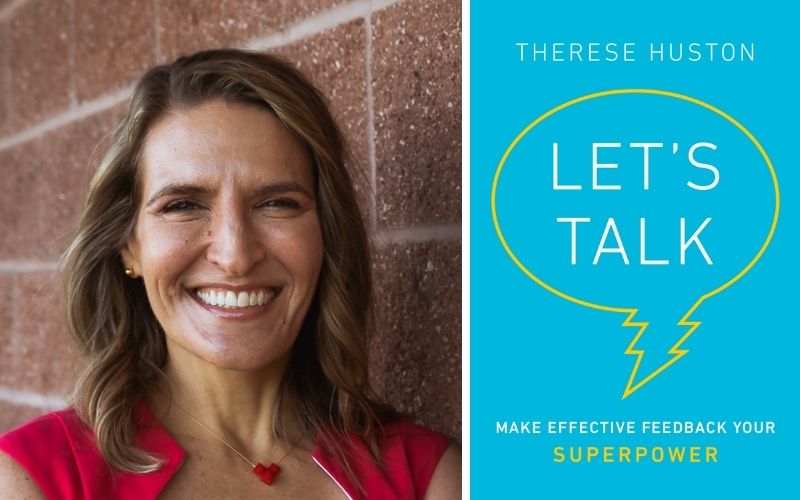
That's why I wanted to read Therese Huston's latest book, Let's Talk: Make Effective Feedback Your Superpower. What I like about her approach is how she humanizes feedback. She asks us to think about our goals. Why are we sharing this feedback, with this particular person, at this time? Then she asks us to think about what's in it for them to receive our feedback.
The result is a genuine conversation. It starts with us sharing why we care about their growth and development. It continues with us sharing the challenge or gap as we see it. Then it means listening to understand their point of view, so that we can work together on a solution.
Approaching feedback this way can break down barriers. It can also help us overcome our hesitation. Ultimately, it can lead to stronger relationships and higher quality work.
Therese was the founding director of the Center for Faculty Development at Seattle University. She's written for The New York Times and Harvard Business Review. I spoke to Therese on the podcast about her previous book, How Women Decide.
Episode Links
Avraham N. Kluger
Why Do So Many Managers Avoid Giving Praise by Jack Zenger and Joseph Folkman
Nine Lies about Work by Marcus Buckingham and Ashley Goodall
The Ideal Praise-to-Criticism Ratio by Jack Zenger and Joseph Folkman
The Progress Principle by Teresa Amabile and Steven Kramer
The 1, 2, 3 Newsletter
6 Things Employees Want to Hear from Their Bosses
The Little Things that Make Employees Feel Appreciated by Kerry Roberts Gibson, Kate O'Leary, and Joseph R. Weintraub
Research: M...
Yet, when we become managers, we often forget this lesson, which means most of the people we manage don't get enough feedback. And it's not because we don't think it helps. It's often because we're afraid. We worry about hurting people's feelings, demotivating them, or creating conflict.
That's why I wanted to read Therese Huston's latest book, Let's Talk: Make Effective Feedback Your Superpower. What I like about her approach is how she humanizes feedback. She asks us to think about our goals. Why are we sharing this feedback, with this particular person, at this time? Then she asks us to think about what's in it for them to receive our feedback.
The result is a genuine conversation. It starts with us sharing why we care about their growth and development. It continues with us sharing the challenge or gap as we see it. Then it means listening to understand their point of view, so that we can work together on a solution.
Approaching feedback this way can break down barriers. It can also help us overcome our hesitation. Ultimately, it can lead to stronger relationships and higher quality work.
Therese was the founding director of the Center for Faculty Development at Seattle University. She's written for The New York Times and Harvard Business Review. I spoke to Therese on the podcast about her previous book, How Women Decide.
Episode Links
Avraham N. Kluger
Why Do So Many Managers Avoid Giving Praise by Jack Zenger and Joseph Folkman
Nine Lies about Work by Marcus Buckingham and Ashley Goodall
The Ideal Praise-to-Criticism Ratio by Jack Zenger and Joseph Folkman
The Progress Principle by Teresa Amabile and Steven Kramer
The 1, 2, 3 Newsletter
6 Things Employees Want to Hear from Their Bosses
The Little Things that Make Employees Feel Appreciated by Kerry Roberts Gibson, Kate O'Leary, and Joseph R. Weintraub
Research: M...