

Show notes
Few of us realize how dependent we are on the people and objects around us for our knowledge. But Steven Sloman does.
He reveals that we are constantly accessing expertise stored in our communities, our technologies, and in our environment. In fact, research reveals that many of us adopt positions on issues like climate change and health care from certain experts, without even realizing it. These findings have enormous implications for our increasingly polarized society, including the fact that educating people about issues is probably not the most effective way to change their minds.
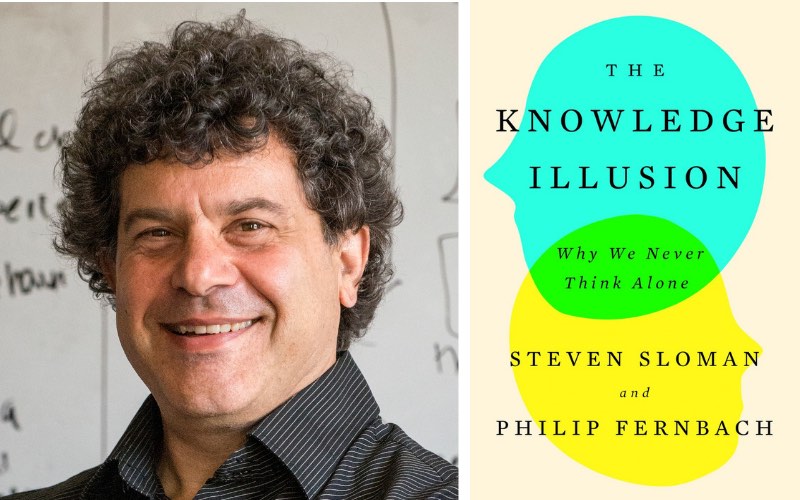
Steven Sloman is co-author of the book, The Knowledge Illusion: Why We Never Think Alone. He is a Professor of Cognitive, Linguistic, and Psychological Sciences at Brown University, and Editor-in-Chief of the journal, Cognition. His work has been featured in publications like the New York Times, Harvard Business Review, and the Wall Street Journal.
In this interview we discuss:
The fact that we tend to think we understand how things work better than we actually do
How we fail to distinguish what we know from what others know
How complexity prevents us from understanding many of the things we think we do
The fact that knowledge must be collective to offset all the complexity in our lives
When we want to understand how the government or our car works, we figure out enough causal structure to solve our problems
What the deliberative mind is good at, which is coming to causal conclusions
How deliberation depends on a community of knowledge and connects us to other people
The unique ability of human beings to share intentionality, that is, to engage in tasks with other people
The limitations of understanding that comes from someone else
How understanding is contagious and community based
Much of our understanding comes from having access to knowledge rather than actually knowing
Why it is important to help people see that they do not understand -- that they cannot explain something they think they understand well
Our conviction that we understand or know something comes from the trust we place in certain experts
The fact that we cannot convince people by making them experts but by convincing them to believe in a different set of experts
That we tend to stick with our first explanation or conclusion, even if it is found to be incorrect
The fact that most of our beliefs are formed independent of data -- they tend to be shaped by our culture and what our community thinks
The fact that the thought leaders we look to actually determine what we believe
How we actually vote for what our communities judge to be the right things, not what the right things might actually be
The fact that group intelligence is derived from how well team members communicate with and relate to one another rather than individual intelligence
How many VCs make investment decisions based on the team and their collective intelligence
That what should spend more time on collective or team intelligence over individual intelligence
A question we can ask individuals whom we hire: How have you contributed to g...
He reveals that we are constantly accessing expertise stored in our communities, our technologies, and in our environment. In fact, research reveals that many of us adopt positions on issues like climate change and health care from certain experts, without even realizing it. These findings have enormous implications for our increasingly polarized society, including the fact that educating people about issues is probably not the most effective way to change their minds.
Steven Sloman is co-author of the book, The Knowledge Illusion: Why We Never Think Alone. He is a Professor of Cognitive, Linguistic, and Psychological Sciences at Brown University, and Editor-in-Chief of the journal, Cognition. His work has been featured in publications like the New York Times, Harvard Business Review, and the Wall Street Journal.
In this interview we discuss:
The fact that we tend to think we understand how things work better than we actually do
How we fail to distinguish what we know from what others know
How complexity prevents us from understanding many of the things we think we do
The fact that knowledge must be collective to offset all the complexity in our lives
When we want to understand how the government or our car works, we figure out enough causal structure to solve our problems
What the deliberative mind is good at, which is coming to causal conclusions
How deliberation depends on a community of knowledge and connects us to other people
The unique ability of human beings to share intentionality, that is, to engage in tasks with other people
The limitations of understanding that comes from someone else
How understanding is contagious and community based
Much of our understanding comes from having access to knowledge rather than actually knowing
Why it is important to help people see that they do not understand -- that they cannot explain something they think they understand well
Our conviction that we understand or know something comes from the trust we place in certain experts
The fact that we cannot convince people by making them experts but by convincing them to believe in a different set of experts
That we tend to stick with our first explanation or conclusion, even if it is found to be incorrect
The fact that most of our beliefs are formed independent of data -- they tend to be shaped by our culture and what our community thinks
The fact that the thought leaders we look to actually determine what we believe
How we actually vote for what our communities judge to be the right things, not what the right things might actually be
The fact that group intelligence is derived from how well team members communicate with and relate to one another rather than individual intelligence
How many VCs make investment decisions based on the team and their collective intelligence
That what should spend more time on collective or team intelligence over individual intelligence
A question we can ask individuals whom we hire: How have you contributed to g...